


Some of us wake up in the morning and already feel that something is wrong.
Before the day has even started, the heart is beating faster, the body is tense, and the thoughts are already racing ahead. Sometimes it’s a feeling of pressure in the chest, sometimes shortness of breath, and sometimes a feeling that’s hard to put into words, as if something bad is about to happen, even when there’s no clear reason for it.
Some people feel this way only in certain situations, while others live in an almost constant state of alertness. Some stop going to certain places, others have trouble sleeping, and some keep up a normal routine on the outside while facing a daily struggle inside that almost no one sees.
If you’ve landed on this page, you may be looking for more than an explanation of anxiety. You may simply want to understand why this is happening to you, whether others experience it too, and whether it’s possible to feel differently.

The important news is that you’re not alone. Anxiety is one of the most common conditions in the world, and in Israel in recent years, more and more people report feelings of tension, alertness, restlessness and sometimes anxiety attacks. It’s just as important to know that there are many treatment options available today, and that the first step is understanding what your body is trying to tell you.
When Reality Itself Puts All of Us on Alert
In recent years, life in Israel has changed significantly. The events of October 7, long periods of security uncertainty, sirens, reserve call-ups, worry for family members and living with an ongoing threat on multiple fronts have all affected many people’s sense of safety.
In times like these, feeling stressed is a completely natural response. Our brain is designed to detect danger and prepare the body to deal with it. When a siren sounds or something out of the ordinary happens, the body reacts exactly as it should: it raises its level of alertness to protect us.
For most people, once the event passes, the body’s alarm system gradually calms down as well.
But for others, something stays “switched on.” Even after the danger has passed, the body keeps acting as though it’s still in an emergency. The heart rate stays high, sleep becomes light and broken, every little noise makes them jump, and their thoughts struggle to stop.
It’s important to understand that this is not weakness or personal failure. In many cases, it’s a response of a nervous system that has remained in a state of high alertness over time, and that is exactly why it’s important to recognize the signs and to know that there are professional ways to help.
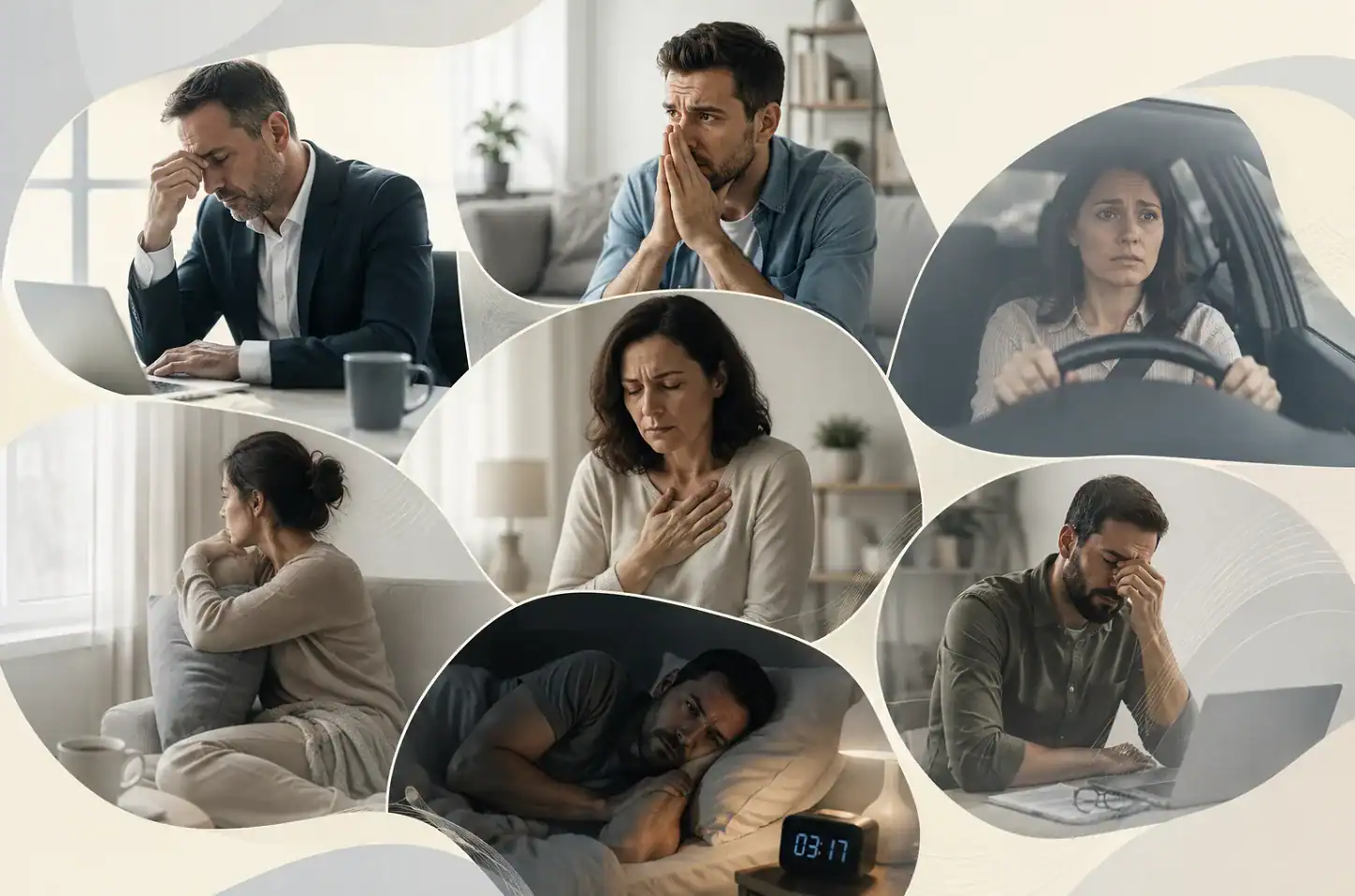
Anxiety Doesn't Always Look the Way You Think - and Why Does the Body React This Way?
When people hear the word “anxiety,” many picture a dramatic anxiety attack or someone who can’t leave the house. In reality, anxiety can look completely different.
Some people keep working, raising children and running a successful business, yet feel that something inside them has changed. They’re more tired, more on edge, find it hard to enjoy things that once came naturally, and live with a constant sense of effort.
Others experience recurring physical symptoms: a racing heart, pressure in the chest, a choking sensation, dizziness or stomach pain. Sometimes they go through many medical tests, all the results come back normal, yet the sensations keep returning, sometimes at night, sometimes in the morning…
Some people avoid driving, flying or crowded places. Some are afraid of being alone. And some simply can’t stop worrying, about themselves, their children, their health, work or the future – even when there’s no immediate danger or certainty that the scenario will actually happen.
Anxiety doesn’t look the same in everyone, so the way to cope with it also needs to be tailored to the individual.
One of the most common questions is: “If I know there’s no danger, why does my body still react as if there is?” The answer lies in the way our brain works.
When the brain detects a threat, it automatically activates the body’s survival system. Stress hormones are released, the heart rate rises, breathing changes and muscles tighten, all to prepare us to deal with danger.
But sometimes, for various reasons, this alarm system becomes especially sensitive. It may react even to situations that aren’t life-threatening, triggering the same physical responses even when there is no real threat.
Because the physical symptoms are completely real, many people are sure that something is wrong with their body. The sensations are not “in your head,” but their source is not necessarily a physical illness; it’s the way the nervous system responds.
When Should You Pause and Ask for Help?
Not all stress requires treatment, and not every busy period is a sign of anxiety.
But if you feel that fear, worry or constant alertness are already running your life, it’s worth pausing for a moment and listening to yourself. Here are some signs to watch for:
- Near-constant alertness and tension
- Sleep problems or trouble falling asleep because your thoughts won’t stop
- Avoiding places or situations you used to enjoy
- Increased sensitivity to noise
- Recurring physical symptoms, such as a racing heart or pressure in the chest
If you recognize several of these signs in yourself, or feel that anxiety is affecting your work, your family or your quality of life, there’s no reason to keep coping alone.
Seeking advice is not a sign of weakness. On the contrary, it can be the first step toward understanding what you’re going through and choosing the right way to deal with it.

What Treatment Options Are Available Today?
In recent years, the field of anxiety treatment has advanced significantly, and today there are a variety of approaches based on research and clinical experience. The choice of treatment depends on the type of anxiety, the severity of the symptoms, the patient’s preferences and the recommendations of professionals.
For some people, psychological therapy provides effective tools for coping with the thought and behavior patterns that accompany anxiety. In other cases, medication may be recommended as part of a broader treatment plan.
Alongside the well-established approaches, innovative treatments based on advanced technologies have also emerged, aiming to influence regulatory mechanisms in the brain and nervous system. In some cases, these treatments may be incorporated into a personal treatment plan, based on a professional evaluation and the patient’s characteristics.
There is no single treatment that suits everyone. That’s why it’s important to have a professional evaluation and choose the approach that best fits each person, rather than looking for a one-size-fits-all solution.
How Is Anxiety Treated at Stella Center Israel?
At Stella Center Israel, we believe that treating anxiety should begin with understanding the person behind the symptoms. Every person has a different life story, different factors that led to the development of their anxiety, and different responses of the body and nervous system. That’s why the process begins with a comprehensive professional evaluation, aimed at understanding the full picture and tailoring the treatment approach to the individual.
One of the unique treatments offered at the center is SGB treatment (Stellate Ganglion Block) – a short medical procedure performed by a specialist physician under ultrasound guidance, in which a local anesthetic is injected into the area of the star-shaped nerve cluster (Stellate Ganglion), a group of nerves in the neck that is part of the sympathetic nervous system.
Among other things, this system is responsible for the body’s well-known stress response (Fight or Flight). In some people living with anxiety or PTSD, this system may remain in a state of hyperarousal even when there is no real danger. The goal of SGB treatment is to help regulate that nerve activity and thereby reduce the ongoing sense of alertness, as part of a comprehensive treatment plan and subject to medical suitability.
The treatment itself takes about 15 minutes and is performed under real-time ultrasound guidance, which allows maximum precision during the procedure. In most cases, the protocol includes two treatments about two weeks apart, and decisions about further follow-up or maintenance treatments are made according to each patient’s condition and progress.
In recent years, SGB treatment has drawn growing interest in the medical community, following studies that examined its effect on anxiety and PTSD symptoms. In Israel, it is recognized as one of the treatment options by the Ministry of Health, the National Council for Post-Trauma and the Ministry of Defense Rehabilitation Department for eligible populations.
Watch Patient Testimonials

At Stella Center Israel, SGB treatment is not seen as a uniform solution for everyone, but as part of a broad, personalized treatment approach. Alongside the medical procedure, patients receive professional support and ongoing evaluation, with the aim of reducing symptoms, improving quality of life and enabling progress in further treatment and rehabilitation when needed.
Sometimes the first step is simply realizing that you don’t have to face this alone.
Interested in treatment for yourself or someone you love?
Request a callback or call us