

Some people live with PTSD for months or even years without realizing that this is what they are going through. They keep working, functioning, raising a family and living what looks like a normal life from the outside, but on the inside, something has changed.
Sometimes it starts with irritability that was never there before. Sometimes with trouble sleeping. At times it is a sense of detachment, constant alertness or a mental exhaustion that simply won’t go away.
In Israel in recent years, especially since the events of October 7 and the ongoing security situation, more and more women and men are experiencing mental and physical symptoms related to trauma, even if they don’t always know what to call it, perhaps out of shame, perhaps from a lack of awareness about PTSD, and perhaps for other reasons.
Reasons Why It's Not PTSD (In My Opinion)
"I've Just Been Irritable Lately"
One of the most common things people with PTSD say is that they have “become irritable.”
Suddenly, patience runs out fast.
Small noises make you jump.
There are angry outbursts that never happened before.
Sometimes there is even guilt after overreacting.
But in many cases, it isn’t really “irritability.”
It is a nervous system stuck in prolonged survival mode.
The body and brain act as if the danger still exists, even when the person is already at home, at work or somewhere safe.
"I'm Just Not Sleeping Well"
PTSD often affects sleep. Some people have trouble falling asleep. Others wake up at every small noise. Some suffer from nightmares, sweating, a racing heart or a sense of alertness even in the middle of the night.
Over time, the lack of sleep itself starts to affect mood, concentration, relationships and the ability to function.
Many people are sure it’s just a stressful period, but when sleep doesn’t return to normal over time, it’s important to find out what is behind it.

"I'm Not the Same Person Anymore"
Some people describe an inner change that is hard to explain.
They are less happy than before. They pull away from people they used to be close to, and from strangers in general. They feel emotionally shut down. They avoid certain places, conversations or situations.
Sometimes they don’t even connect the event they went through with what is happening to them today.
PTSD doesn’t always look like it does in the movies.
Not everyone who experiences trauma will have dramatic flashbacks. Sometimes the damage shows up precisely as quiet, distance, fatigue or a sense of disconnection from life.
"I'm Just a Little Stressed"
Stress is a natural part of life, but when the body stays constantly on alert over a long period, it may be something deeper.
People with PTSD may experience:
- Constant alertness to a danger that isn’t really there, meaning a sense of danger even in a safe environment
- Difficulty relaxing
- Jumping at small noises
- Mental and physical exhaustion
- Difficulty concentrating
- Avoiding certain situations
In many cases, the person has already gotten used to living this way, so they don’t always realize that something has truly changed.
What Happens in the Body With PTSD?
PTSD doesn’t only affect thoughts or emotions; it also affects the nervous system itself.
For many people with PTSD or anxiety, the “fight or flight” system stays active long after the event has ended. As a result, physical and mental symptoms appear, such as hyperarousal, anxiety attacks, irritability, sleep problems, ongoing tension and a constant sense of alertness.
In recent years, advanced treatment approaches have been developed around the world that aim to help calm the nervous system and reduce the physiological symptoms of trauma and anxiety.

Targeted Medical Treatment to Relieve PTSD and Anxiety Symptoms
Stella Center Israel was founded in 2022 and is part of the global Stella network, which treats thousands of patients in the United States, Australia and Israel.
The treatment Stella offers is called Stellate Ganglion Block (SGB). It is a short medical procedure involving two injections of local anesthetic on the side of the neck. The injections are performed by a licensed physician under ultrasound guidance throughout the entire procedure, for maximum safety and precision.
The treatment targets a nerve area linked to the “fight or flight” system, the same system that, in some people with PTSD and anxiety, remains in a state of ongoing arousal long after the traumatic event.
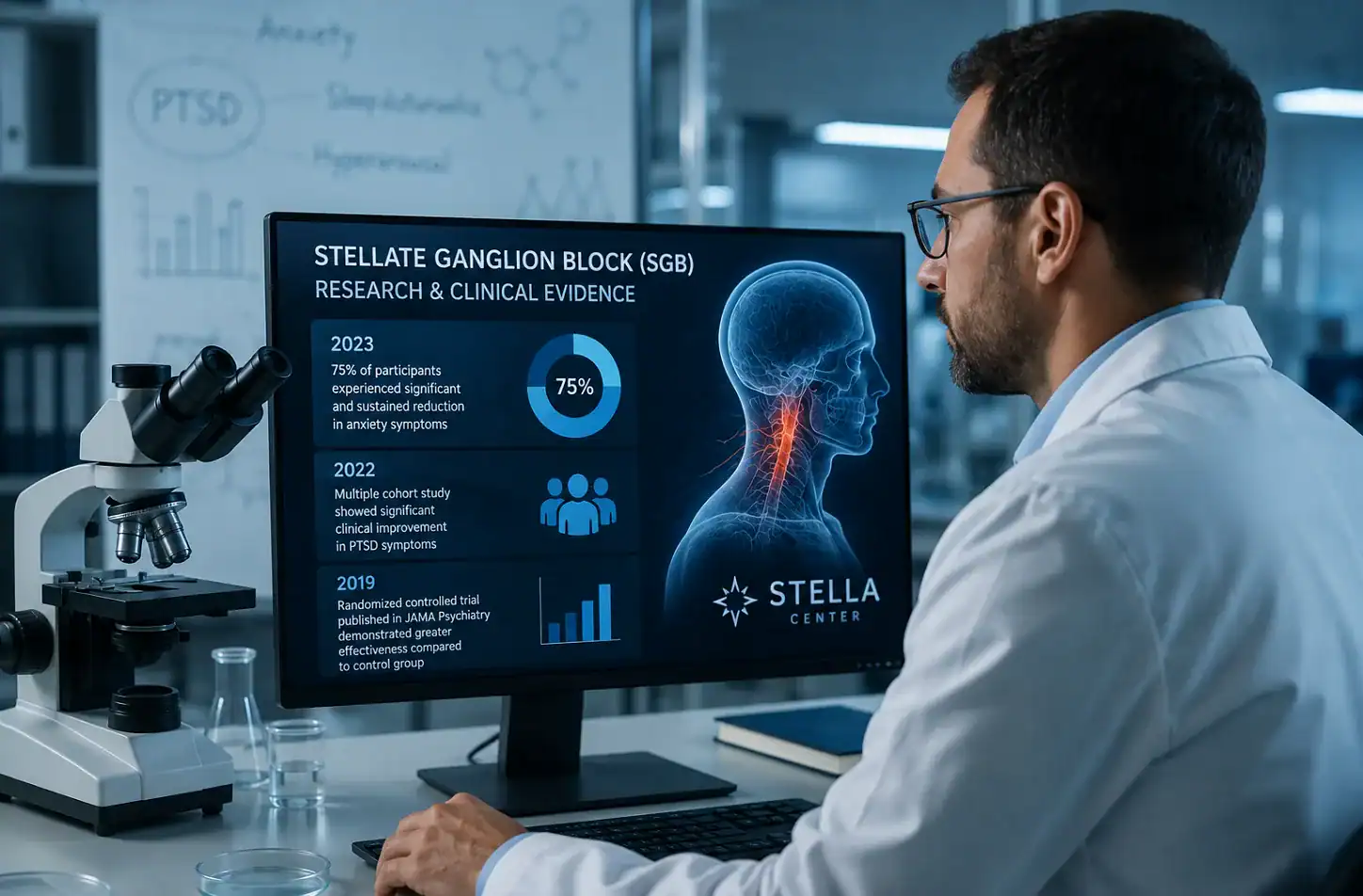
At Stella, we describe the procedure as a kind of “reboot” of the sympathetic nervous system, intended to help the body get out of prolonged survival mode. Many patients (over 75%) report feeling calmer after treatment, with a significant reduction in symptoms such as anxiety attacks, hyperarousal, irritability and sleep problems.
What Should You Know About SGB Treatment?
- The treatment itself takes only about 20 minutes
- Recovery time is relatively quick
- The treatment does not impair alertness or reaction time
- Most patients report significant symptom relief after two treatments
- In many cases, the improvement lasts for months and even years
In addition, we recommend combining the treatment with psychological support or other supportive therapies.
Science Continues to Study the Field
SGB has been studied around the world for decades. In recent years, studies have been published examining its effectiveness in treating PTSD and anxiety disorders.
Studies include:
• A 2022 study that reviewed several patient groups and showed significant clinical improvement in PTSD symptoms (view the study)
• A randomized study published in JAMA Psychiatry in 2019 that showed greater effectiveness compared with a control group (view the study)
Good to know: there is something you can do
Many people live for years with symptoms of PTSD without realizing that this is what they are experiencing.
Sometimes they are sure they are just “stressed,” “irritable” or “tired.”
But when these feelings persist over time and harm quality of life, it’s important to know that you don’t have to deal with it alone.
Today there are various treatment options, including advanced medical approaches, that can help reduce symptoms and bring back a sense of calm and control to your life.
For more information and to schedule an appointment, leave your details for a callback or call us at 073-332-9259
Interested in treatment for yourself or a loved one?
Leave your details for a callback or call us